
Assessing the Carbon Footprint of Digital Research Infrastructures through Lifecycle Analysis
Authors: Jérôme Pansanel, Lauriane Kuhn and Vincent Legoll
Context
Digital technologies have become essential to modern research, enabling large-scale data processing, simulation, and collaboration across disciplines. However, their environmental footprint is increasingly significant, with the digital sector estimated to account for around 4% of global greenhouse gas emissions.
Within this context, the GreenDIGIT project develops methods and tools to assess and reduce the environmental impact of digital Research Infrastructures (RIs). A key outcome of the project is the definition of harmonised metrics and methodologies, as described in its deliverable D3.2, enabling consistent evaluation across infrastructures.
Among the various environmental indicators, this work focuses on carbon emissions, expressed as Global Warming Potential (GWP), a standard metric used to quantify climate change impact. While other dimensions such as waste or water usage are relevant, they require complex datasets that are not always accessible. Carbon footprint, by contrast, provides a robust and actionable entry point for sustainability assessment.
Lifecycle Assessment Method
The study applies a Lifecycle Assessment (LCA) approach, a standardised method used to evaluate environmental impacts across the entire lifecycle of a system, in accordance with ISO 14040 principles. This methodology quantifies greenhouse gas emissions at every stage of a system’s lifecycle, from production to end-of-life. It enables the assessment of part of the RI Direct Impact, as illustrated in Figure 1.
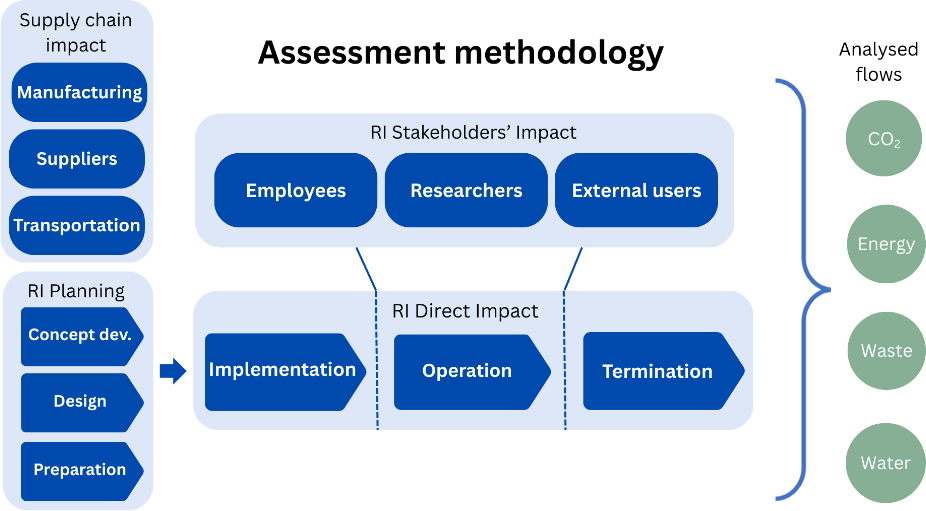 RI lifecycle scope definition: Assessment methodology
The analysis is structured into four phases: goal and scope definition, inventory analysis, impact assessment, and interpretation. For digital infrastructures, this includes:
- hardware manufacturing and transport
- infrastructure deployment (installation and integration)
- operational energy consumption
- end-of-life processes (reuse, recycling, disposal)
Within GreenDIGIT, this approach is aligned with ESFRI lifecycle models and integrates best practices in sustainability assessment. The objective is to provide a method applicable to real-world RI services.
Scope and Key Findings
The methodology was applied to digital services operated at one site of the EGI Federation, covering compute and storage systems and their supporting infrastructure. This LCA focuses on carbon emissions while preserving the main lifecycle dynamics.
To ensure a pragmatic and reproducible approach, the analysis relies on:
- a complete infrastructure inventory
- annual electricity consumption and its CO2 equivalent (CO2e) based on data provided by the French electricity transmission system operator (RTE company)
- emission factors for manufacturing and energy (based on data from the French Environment and Energy Management Agency and the EcoInfo research group of the CNRS)
- differentiated equipment lifetime assumptions, with an average of 7 years for IT hardware and up to 15 years for infrastructure components such as cooling and power systems
The results reveal that the majority of carbon emissions (75 %) are associated with the manufacturing phase of hardware. This result highlights the dominant role of embodied carbon, even in relatively energy-efficient contexts. It is consistent with other studies, like the greenhouse gas emission assessment conducted by CNRS in 2025, concluding that 74% of emission are related to equipment procurement.
Affected by infrastructure efficiency and electricity carbon intensity (gCO2e per kWh), the energy consumption remains a significant factor (~ 20 %). As its relative contribution is lower than expected when considering the full lifecycle, it appears that the result may be influenced by the low-carbon electricity mix in France, which significantly reduce emissions associated with electricity use. As a consequence, the operational phase appears less dominant compared to contexts where electricity production is more carbon-intensive. This highlights the importance of geographical context when interpreting lifecycle assessment results.
Within GreenDIGIT, this limitation is being addressed by ongoing work on dynamic carbon accounting. Deliverable D6.1 presents functional mechanisms to integrate real-time carbon intensity data, leveraging platforms such as WattNet. This approach enables more accurate and context-aware assessments of operational emissions.
Conclusions
This lifecycle-based assessment highlights the need to rethink sustainability strategies for digital research infrastructures.
Improving energy efficiency alone is not sufficient. Instead, a broader approach is required, addressing the full lifecycle of equipment. Key recommendations include:
- extending hardware lifetime to reduce annualised impact
- adopting modular and demand-driven procurement strategies
- improving reuse and recycling processes
- integrating environmental criteria into infrastructure design and operation
More broadly, this work demonstrates the value of the GreenDIGIT framework in supporting evidence-based decision-making. By combining lifecycle assessment with harmonised metrics, it enables RIs to better understand their environmental footprint and identify effective mitigation strategies.
As a next step, this lifecycle assessment will be refined using more detailed manufacturer data, taking into account the full composition of the infrastructure, including individual hardware components such as processors, memory, and storage devices. This will improve the accuracy of the results and provide a more precise understanding of the environmental impact of digital research infrastructures.