A Lifecycle-Based Environmental Impact Assessment Methodology for Sustainable Digital Research Infrastructures
Iida Lehto, Mandat International
GreenDIGIT Project | July 2026
Reducing the environmental impact of digital services and technologies must be a priority both in the operation of existing services and in the design of future digital research infrastructures (RIs). To support this objective, the GreenDIGIT project has developed an Environmental Impact Assessment Methodology and accompanying guidelines specifically for digital Research Infrastructures.
The methodology enables RIs to assess environmental impacts related to carbon emissions, energy consumption, waste management, and water use across their lifecycle. It combines lifecycle assessment principles with a practical framework for prioritising sustainability actions and is complemented by the GreenDIGIT Self-Assessment Questionnaire (SAQ), which supports implementation, monitoring, and reporting. So far, the methodology has been tested and validated by the participating GreenDIGIT Research Infrastructures, including EGI, EBRAINS, SoBigData, and SLICES.
A Lifecycle-Based Approach to Environmental Sustainability
The GreenDIGIT methodology uses a lifecycle perspective aligned with the ESFRI Research Infrastructure lifecycle model. Rather than focusing solely on operational impacts, it considers environmental impacts throughout the entire RI lifecycle, from planning and implementation to operation and termination.
The assessment includes both direct impacts under the RI’s operational control and indirect impacts throughout the value chain. Particular attention should be paid to embodied carbon, which represents emissions associated with raw material acquisition, production, end-of-life (EoL) treatment, and across supply chain and stakeholder impacts.
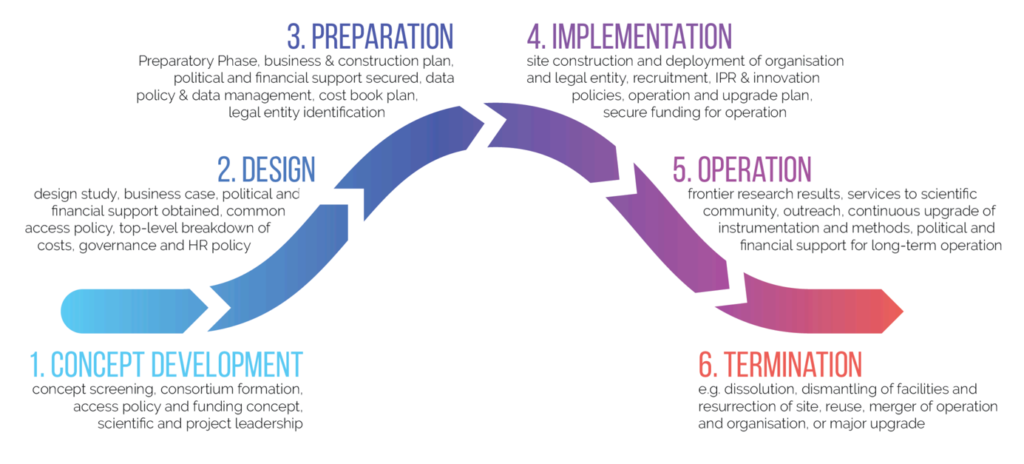
Figure 1. ESFRI lifecycle model.
Environmental Impact Categories and Metrics
The methodology focuses on four key environmental impact categories selected based on ISO 14040 lifecycle assessment principles and ICT-specific guidance from ITU-T L.1410:
- Global Warming Potential (GWP) to assess greenhouse gas emissions;
- Cumulative Energy Demand (CED) to evaluate energy consumption throughout the lifecycle;
- Waste Electrical and Electronic Equipment (WEEE) to measure electronic waste generation;
- Resource Depletion: Water (RDW) to assess water consumption.
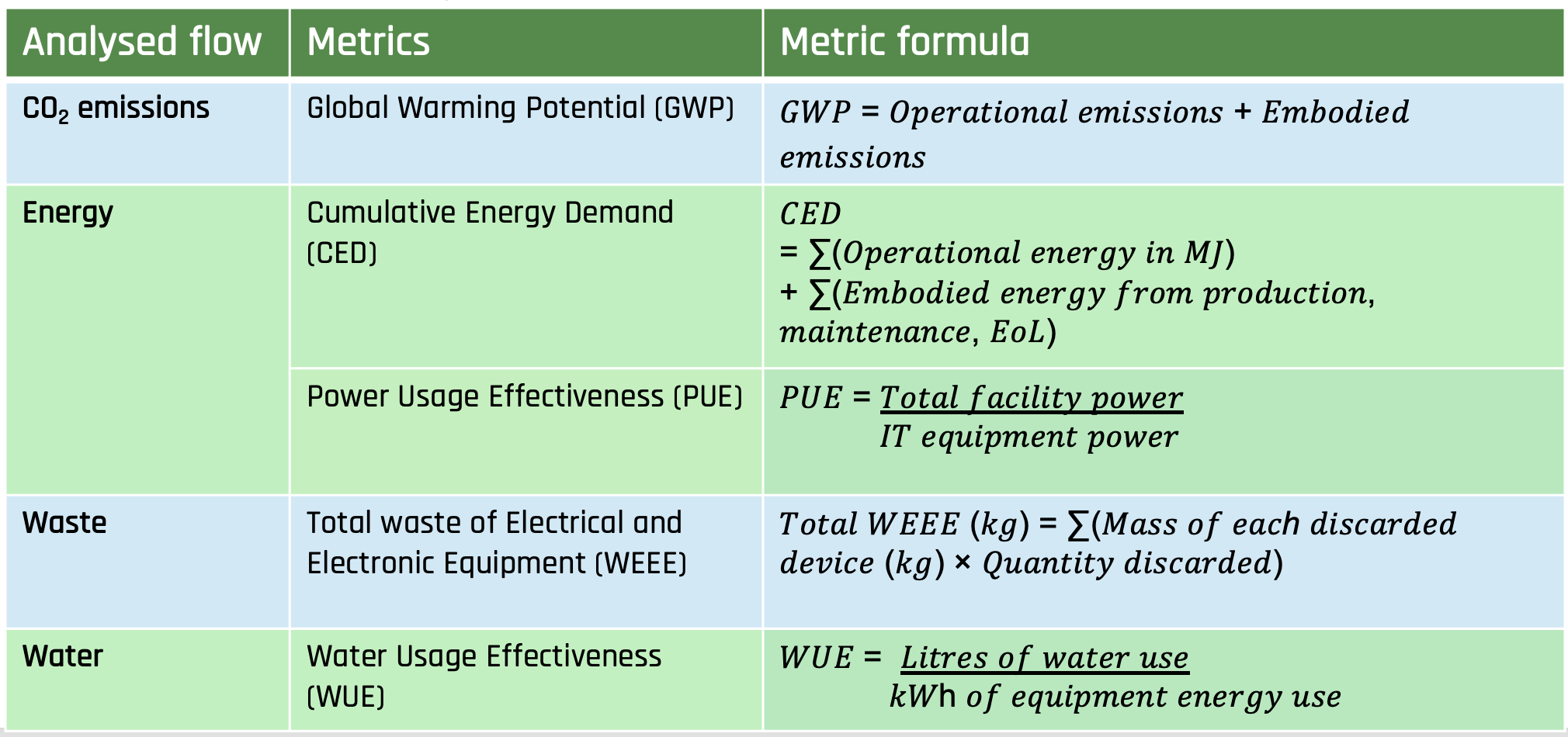
Additional operational metrics, including Power Usage Effectiveness (PUE) and Water Usage Effectiveness (WUE), support the monitoring of infrastructure performance and sustainability improvements.
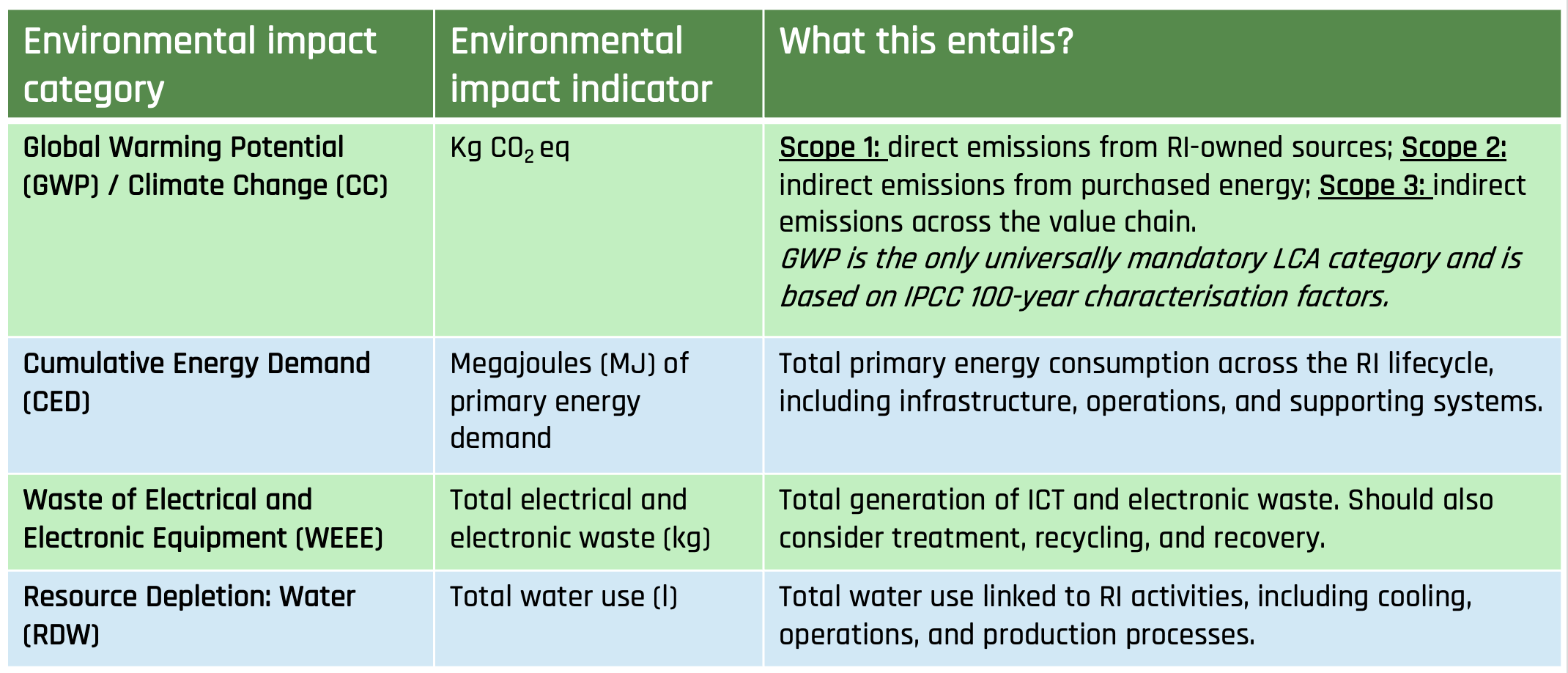
*Please note that while total water use (l) gives a first overview into the water category, this alone does not account for overall depletion impact where a given region’s water availability would need to be accounted for. Lifecycle Impact Assessment (LCIA) methods, like AWARE (Available WAter REmaining) could be used to develop impact factors (i.e. water deprivation per region) that convert water use into RDW impact units, such a ‘m3 water-equivalents’ or ‘m3 deprived’.
From Assessment to Action
The GreenDIGIT methodology consists of six sequential steps: defining the assessment scope, assessing current capability levels, identifying recommended actions, determining priorities, formalising action plans, and monitoring progress.
A key feature of the methodology is its prioritisation framework, which helps RIs identify and implement the most impactful sustainability actions. Priorities are determined using three assessment parameters: impact magnitude, likelihood, and effort required, enabling RIs to allocate resources effectively and focus on actions with the greatest potential benefit.
Implementing the Methodology with the Self-Assessment Questionnaire (SAQ)
To support practical implementation, the methodology is complemented by the Self-Assessment Questionnaire (SAQ), which is currently being further refined and developed into a web-based format. It translates the methodology into a practical tool that guides RIs through the assessment steps, automatically identifies recommended actions, and prioritises them according to the specific capability and assessment responses from the RI. Finally, it supports action monitoring and reporting on the RI’s sustainability journey.
Tools, Metrics, and Access
GreenDIGIT Deliverable D3.2: Environmental Impact Assessment Methodology and Guidelines for Research Infrastructures: https://zenodo.org/records/19488358
GreenDIGIT Deliverable D8.1: Self-Assessment Questionnaire: https://zenodo.org/records/17210726
Reference frameworks: ISO 14040, ITU-T L.1410, ESFRI lifecycle framework
Key metrics: GWP, CED, WEEE, RDW, PUE, and WUE
Summary
The Environmental Impact Assessment Methodology developed within GreenDIGIT provides a framework for assessing and improving the environmental sustainability of digital Research Infrastructures. By combining lifecycle assessment principles with capability-based evaluation and action prioritisation, the methodology supports RIs in identifying environmental impacts, implementing targeted improvements, and monitoring progress over time.
Together with the Self-Assessment Questionnaire to practically implement the methodology steps, this work is now used as a benchmark for subsequent GreenDIGIT activities in WP9 to develop a certification baseline and a package to support green evolution of digital RIs.